
SBZ Weighted Least Squares Bubble Test with Union-of-Rejections
Source:R/radf_sbz.R
radf_sbz_union.Rdradf_sbz_union performs the HLST (2016) wild bootstrap, the same
algorithm as radf_wb_cv, jointly on the classic sup-ADF
statistic (supDF, that is, the sadf of radf()) and on the
WLS/kernel-volatility statistic supBZ of Harvey, Leybourne & Zu (2019).
It combines them into the union-of-rejections statistic U of the paper.
supBZ can have substantially higher power than supDF under many
patterns of time-varying volatility, and lower power under others, for example
upward volatility trends. U is designed to capture whichever of the two
is more powerful for a given series.
Usage
radf_sbz_union(
  data,
  minw = NULL,
  nboot = 499L,
  kernel = c("gaussian", "uniform"),
  h = NULL,
  seed = NULL
)
Arguments
- data
A univariate or multivariate numeric time series object, a numeric vector or matrix, or a data.frame. A column may have leading or trailing
NAvalues, which describes an unbalanced panel in which series enter or exit the sample at different times. Those periods are filled withNAinbadfandbsadfand excluded from theadf,sadfandgsadfof that series. InteriorNAvalues (a gap in the middle of a series) are not supported. When any series is padded in this way, the panel statistics (bsadf_panelandgsadf_panel) are not available, and the function returnsNAfor them with a warning.- minw
A positive integer. The minimum window size (default = \((0.01 + 1.8/\sqrt{T})T\), where T denotes the sample size).
- nboot
A positive integer. Number of bootstraps (default = 500L).
- kernel
Kernel for the spot-volatility estimator (eq. 6),
"gaussian"(default, as in the paper) or"uniform".- h
Bandwidth for the spot-volatility estimator. The default is leave-one-out cross-validation over the search range of the paper.
- seed
An object specifying if and how the random number generator (rng) should be initialized. It is either NULL or an integer, which is passed to
set.seedbefore the simulation. If you set it, the value is saved as the "seed" attribute of the returned value. The default, NULL, leaves the state of the rng unchanged and returns .Random.seed as the "seed" attribute. Results are reproducible across the parallel and the non-parallel option when you use the same seed.
Value
A list with bootstrap p-values (p_supDF, p_supBZ,
p_U) and critical values (supDF_cv, supBZ_cv,
U_cv) for each series.
Details
The value of U, and not only its significance, is defined with a
bootstrap-calibrated scaling ratio between the 95\
supDF and supBZ (Section 2.3 of the paper). The union also keeps
its size guarantee (Theorem 3 of the paper) only if the joint bootstrap computes
supDF and supBZ from the same resampled series in each
replication. This coupling is why the function stays a single bundled function,
and does not split into a statistic and a critical-value function as most of
exuber does. supBZ alone has no such coupling, so it does split. See
radf_sbz and radf_sbz_cv for the route that uses
only supBZ, with the usual summary(), datestamp,
tidy and autoplot pipeline.
Note
This function bundles the statistic and its critical values in a single
call. Unlike radf() and radf_wb_cv(), there is no separate
statistic function without critical values and no other critical-value function
to pair it with, because the value of U requires the bootstrap by
construction (see Details).
The function returns its own class and not radf_obj, so it does not work
with summary(), \link{datestamp} and tidy. It has its own print() and
autoplot() methods instead. print() shows the test statistics together with
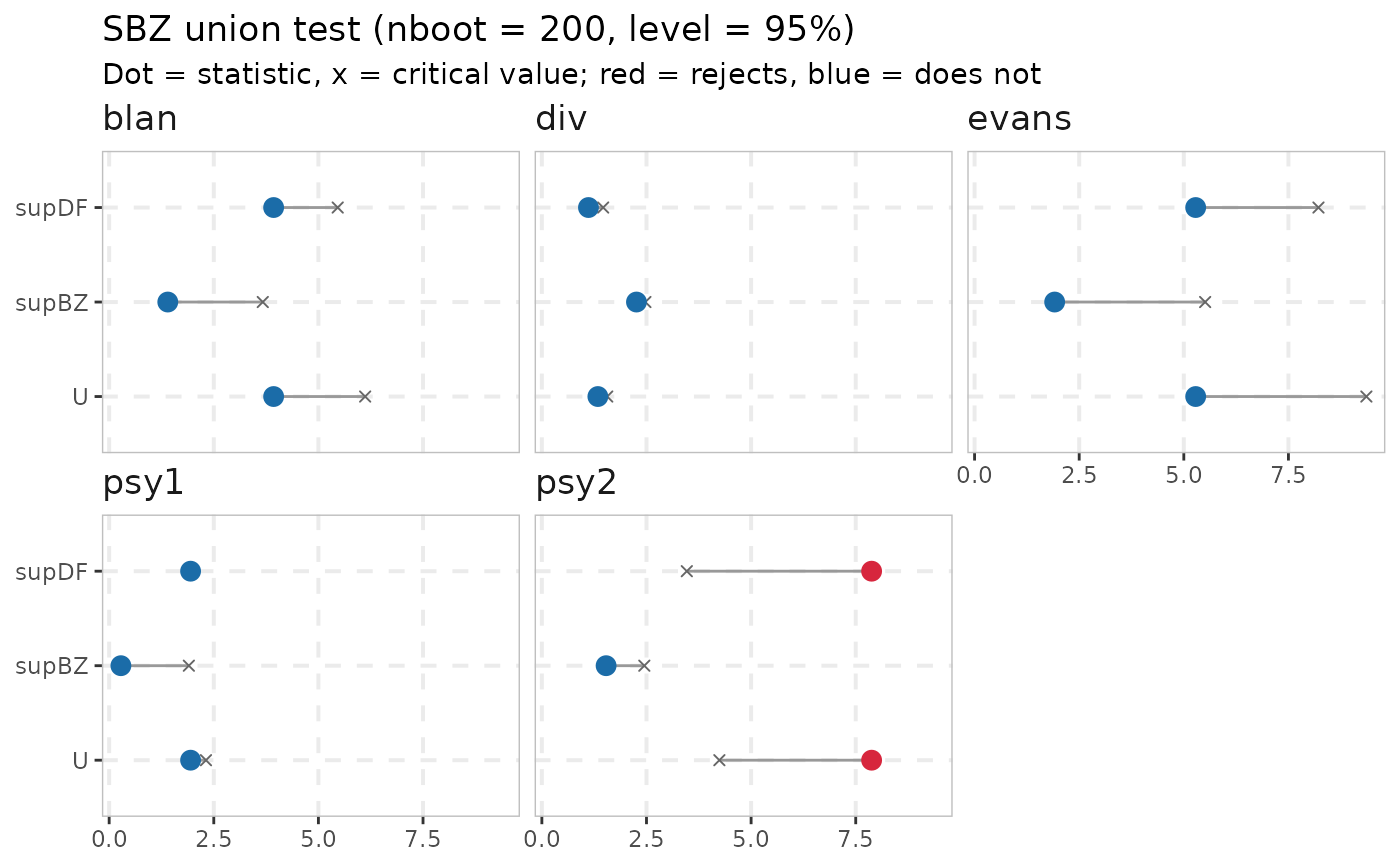
their critical values, because the object bundles both. The autoplot() method
compares supDF, supBZ and U with their critical values for
each series. See vignette("naming-and-analysis", package = "exuber") for
which functions fit the shared pipeline and which do not.
![[Experimental]](figures/lifecycle-experimental.svg)
References
Harvey, D. I., Leybourne, S. J., & Zu, Y. (2019). Testing explosive bubbles with time-varying volatility. Econometric Reviews, 38(10), 1131-1151.
See also
radf_wb_cv for the underlying wild bootstrap, which uses
supDF only, radf_sbz and radf_sbz_cv for the
route that uses supBZ only and has full pipeline support, and
radf_tt for a heteroskedasticity-robust alternative that needs no
bootstrap.
Other volatility-robust tests:
cusum_test(),
radf_kp(),
radf_sbz(),
radf_sign(),
radf_sign_dm(),
radf_tt(),
ssu_test()
Examples
# \donttest{
y <- sim_psy1(n = 200, te = 120, tf = 200, c = 0.03, alpha = 0, seed = 1,
e = sim_vol_break(199))
res <- radf_sbz_union(y, nboot = 200, seed = 1)
print(res)
#>
#> ── radf_sbz_union (minw = 27, nboot = 200) ─────────────────────────────────────
#>
#> series supDF supBZ U p_supDF p_supBZ p_U
#> series1 9.264 4.829 9.264 0 0.005 0.005
#>
autoplot(res)
 # }
# }