
Computes the origination, termination and duration of the episodes in which a time series shows explosive dynamics.
Usage
datestamp(object, cv = NULL, min_duration = 0L, ...)

# S3 method for class 'radf_obj'
datestamp(
  object,
  cv = NULL,
  min_duration = 0L,
  sig_lvl = 95,
  option = c("gsadf", "sadf", "svadf"),
  nonrejected = FALSE,
  ...
)
Arguments
- object
An object of class
obj.- cv
An object of class
cv.- min_duration
The minimum duration of an explosive period for it to be reported (default = 0).
- ...
Further arguments passed to methods.
- sig_lvl
Significance level, one of 90, 95 or 99. It is ignored when
option = "svadf".- option
One of
"gsadf"or"sadf", which date episodes (PWY/PSY) against the critical values incv, or"svadf", the SV-ADF asymmetric-threshold dating of Sarkar & Wells (2026). The"svadf"option compares thebadfsequence ofradf()with two closed-form thresholds that depend only on the sample size,log(t)/10for origination andlog(t)/2for collapse, so it needs nocv. See Caveats.- nonrejected
logical. Whether to apply the datestamping technique to the series that do not reject the null hypothesis. It is ignored when
option = "svadf".
Value
A table with the following columns:
Start:
Peak:
End:
Duration:
Signal:
Ongoing:
A list with the estimated origination and termination dates of the episodes of explosive behavior and their duration.
Details
datestamp also stores a vector that takes the value 1 when there is a
period of explosive behavior and 0 otherwise. You can use it as a dummy
variable for the occurrence of exuberance.
Caveats
option = "svadf": ![[Experimental]](figures/lifecycle-experimental.svg) Sarkar & Wells (2026) is a preprint that has not been peer reviewed, which is a
weaker standard of evidence than for every other source this package
implements. The function emits the same note as a message when you call it with
this option. It detects at most one origination and collapse pair per series, as
the procedure of the paper does, and it does not find every recurring episode as
Sarkar & Wells (2026) is a preprint that has not been peer reviewed, which is a
weaker standard of evidence than for every other source this package
implements. The function emits the same note as a message when you call it with
this option. It detects at most one origination and collapse pair per series, as
the procedure of the paper does, and it does not find every recurring episode as
"gsadf" and "sadf" do.
References
Phillips, P. C. B., Shi, S., & Yu, J. (2015). Testing for Multiple Bubbles: Historical Episodes of Exuberance and Collapse in the S&P 500. International Economic Review, 56(4), 1043-1078. doi:10.1111/iere.12132
Sarkar, A., & Wells, M. T. (2026). Is there an AI bubble? Robust date-stamping for periods of exuberance. arXiv:2604.12062.
Examples
rsim_data <- radf(sim_data)
# SV-ADF asymmetric-threshold dating (no critical values needed)
datestamp(rsim_data, option = "svadf")
#> Experimental. Sarkar & Wells (2026) is a non-peer-reviewed preprint; see ?datestamp, Caveats section.
#>
#> ── Datestamp (min_duration = 0) ──────────────── SV-ADF (Sarkar & Wells 2026) ──
#>
#> ℹ Experimental. Sarkar & Wells (2026) is a non-peer-reviewed preprint; see ?datestamp, Caveats section.
#>
#> psy1 :
#> Start Peak End Duration Signal Ongoing
#> 1 48 48 49 1 positive FALSE
#>
#> psy2 :
#> Start Peak End Duration Signal Ongoing
#> 1 23 23 24 1 positive FALSE
#>
#> evans :
#> Start Peak End Duration Signal Ongoing
#> 1 20 20 21 1 positive FALSE
#>
#> div :
#> Start Peak End Duration Signal Ongoing
#> 1 22 22 23 1 positive FALSE
#>
#> blan :
#> Start Peak End Duration Signal Ongoing
#> 1 35 36 37 2 positive FALSE
#>
# \donttest{
# The default `cv` is fetched from the shared critical-value store
# (network on first use); pass `cv = radf_mc_cv(nrow(sim_data))` to stay offline
ds_data <- datestamp(rsim_data)
#> Using precomputed critical values for `cv`.
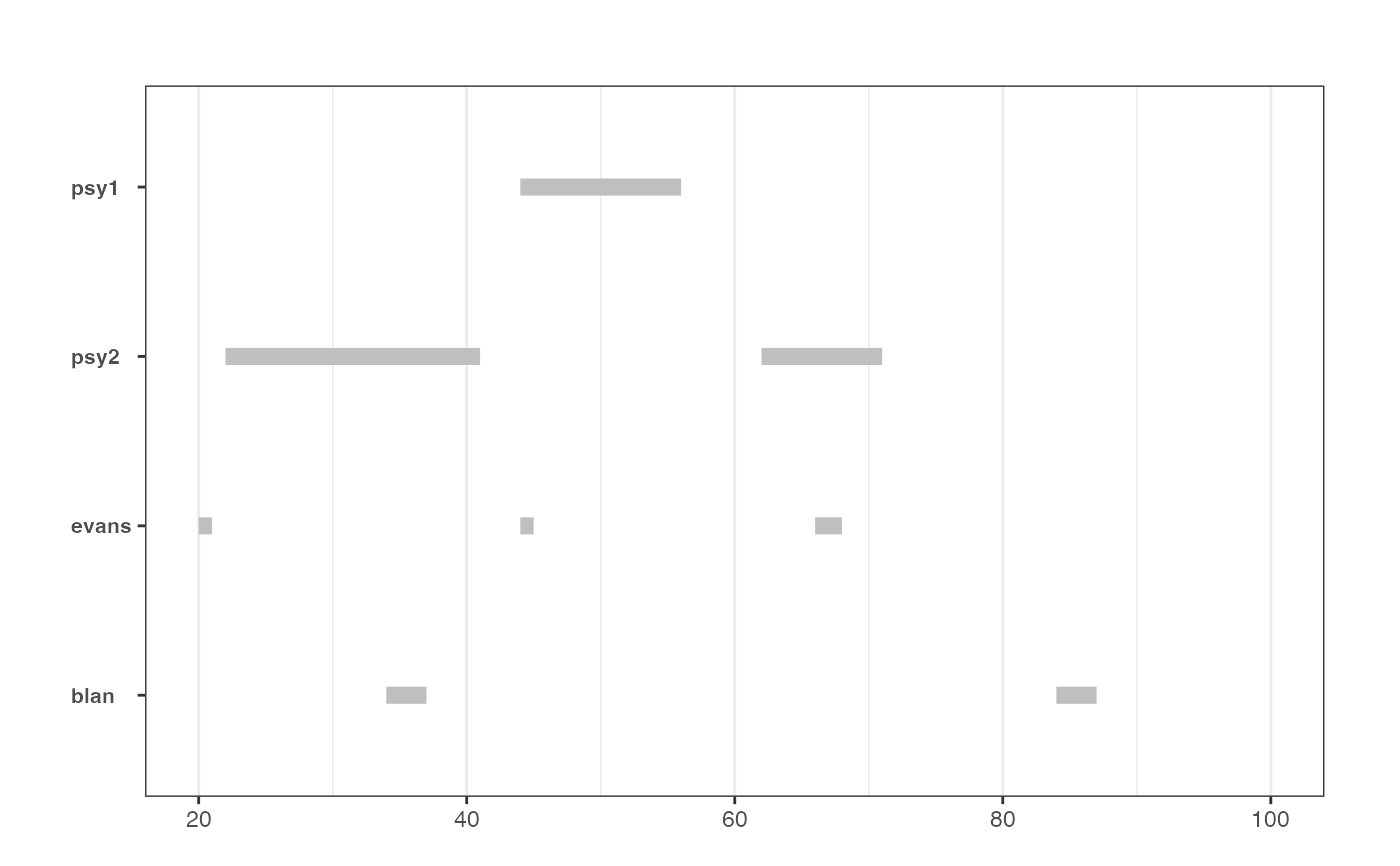
ds_data
#>
#> ── Datestamp (min_duration = 0) ───────────────────────────────── Monte Carlo ──
#>
#> psy1 :
#> Start Peak End Duration Signal Ongoing
#> 1 44 48 56 12 positive FALSE
#>
#> psy2 :
#> Start Peak End Duration Signal Ongoing
#> 1 23 40 41 18 positive FALSE
#> 2 62 70 71 9 positive FALSE
#>
#> evans :
#> Start Peak End Duration Signal Ongoing
#> 1 20 20 21 1 positive FALSE
#> 2 44 44 45 1 positive FALSE
#> 3 66 67 68 2 positive FALSE
#>
#> blan :
#> Start Peak End Duration Signal Ongoing
#> 1 34 36 37 3 positive FALSE
#> 2 84 86 87 3 positive FALSE
#>
# Choose minimum window
datestamp(rsim_data, min_duration = psy_ds(nrow(sim_data)))
#> Using precomputed critical values for `cv`.
#>
#> ── Datestamp (min_duration = 5) ───────────────────────────────── Monte Carlo ──
#>
#> psy1 :
#> Start Peak End Duration Signal Ongoing
#> 1 44 48 56 12 positive FALSE
#>
#> psy2 :
#> Start Peak End Duration Signal Ongoing
#> 1 23 40 41 18 positive FALSE
#> 2 62 70 71 9 positive FALSE
#>
autoplot(ds_data)
 # }
# }