CUSUM and CUSUM-of-Squares Bubble Tests (Kurozumi & Nishi 2025)
Source:R/cusum_test.R
cusum_test.Rdcusum_test implements the retrospective CUSUM ("cs"), generalized
CUSUM ("gcs"), CUSUM-of-squares ("cssq") and generalized
CUSUM-of-squares ("gcssq") tests of Kurozumi & Nishi (2025). These are the
parameter-constancy statistics of Brown et al. (1975), applied to the first
differences. The generalized versions take the supremum over every window start
as well as every end point.
Usage
cusum_test(data, sig_lvl = 95, type = c("cs", "gcs", "cssq", "gcssq"))Arguments
- data
A univariate or multivariate numeric time series object, a numeric vector or matrix, or a data.frame. A column may have leading or trailing
NAvalues, which describes an unbalanced panel in which series enter or exit the sample at different times. Those periods are filled withNAinbadfandbsadfand excluded from theadf,sadfandgsadfof that series. InteriorNAvalues (a gap in the middle of a series) are not supported. When any series is padded in this way, the panel statistics (bsadf_panelandgsadf_panel) are not available, and the function returnsNAfor them with a warning.- sig_lvl
Significance level on the 0 to 100 scale used throughout the package, one of
90,95or99.- type
One of
"cs","gcs","cssq"or"gcssq".
Value
An object of class cusum_test_obj: a list with the statistic path
stat (one value for each end point, and for the generalized versions the
sup over window starts), stat_inf (the inf path, for CSSQ and GCSSQ only),
the statistic sup (and inf), the critical values crit and
detected.
Details
CS and GCS reject when the cumulated increments become too large (right tail).
CSSQ and GCSSQ are two-sided. They reject when the cumulated squared increments
drift too far above or below their full-sample average, with half the level
in each tail. The paper finds that the CUSUM-type tests lose almost all their
power once the explosive coefficient is stochastic, while the CUSUM-SQ type
keeps it. See ssu_test for the more powerful statistics of the
paper.
Note
All critical values are published asymptotic values (Table I of Kurozumi & Nishi 2025). No minimum window is needed, because the paper finds the statistics insensitive to it.
![[Experimental]](figures/lifecycle-experimental.svg)
References
Kurozumi, E., & Nishi, M. (2025). Bubble testing with stochastically varying explosive coefficient. Journal of Time Series Analysis, 46(5), 945-965.
Brown, R. L., Durbin, J., & Evans, J. M. (1975). Techniques for testing the constancy of regression relationships over time. Journal of the Royal Statistical Society B, 37(2), 149-192.
See also
ssu_test, and monitor_cusum for real-time
CUSUM monitoring.
Other volatility-robust tests:
radf_kp(),
radf_sbz(),
radf_sbz_union(),
radf_sign(),
radf_sign_dm(),
radf_tt(),
ssu_test()
Examples
y <- sim_psy1(n = 150, te = 75, tf = 150, c = 3, alpha = 1, seed = 2001,
  coef_noise = rnorm(149), coef_a = 4)
cusum_test(y, type = "cssq")
#>
#> ── cusum_test (CSSQ, n = 150, sig_lvl = 95%, crit = 1.32 / -1.34) ──────────────
#>
#>    series     sup     inf  detected
#>   series1  0.3095  -1.688      TRUE
#>
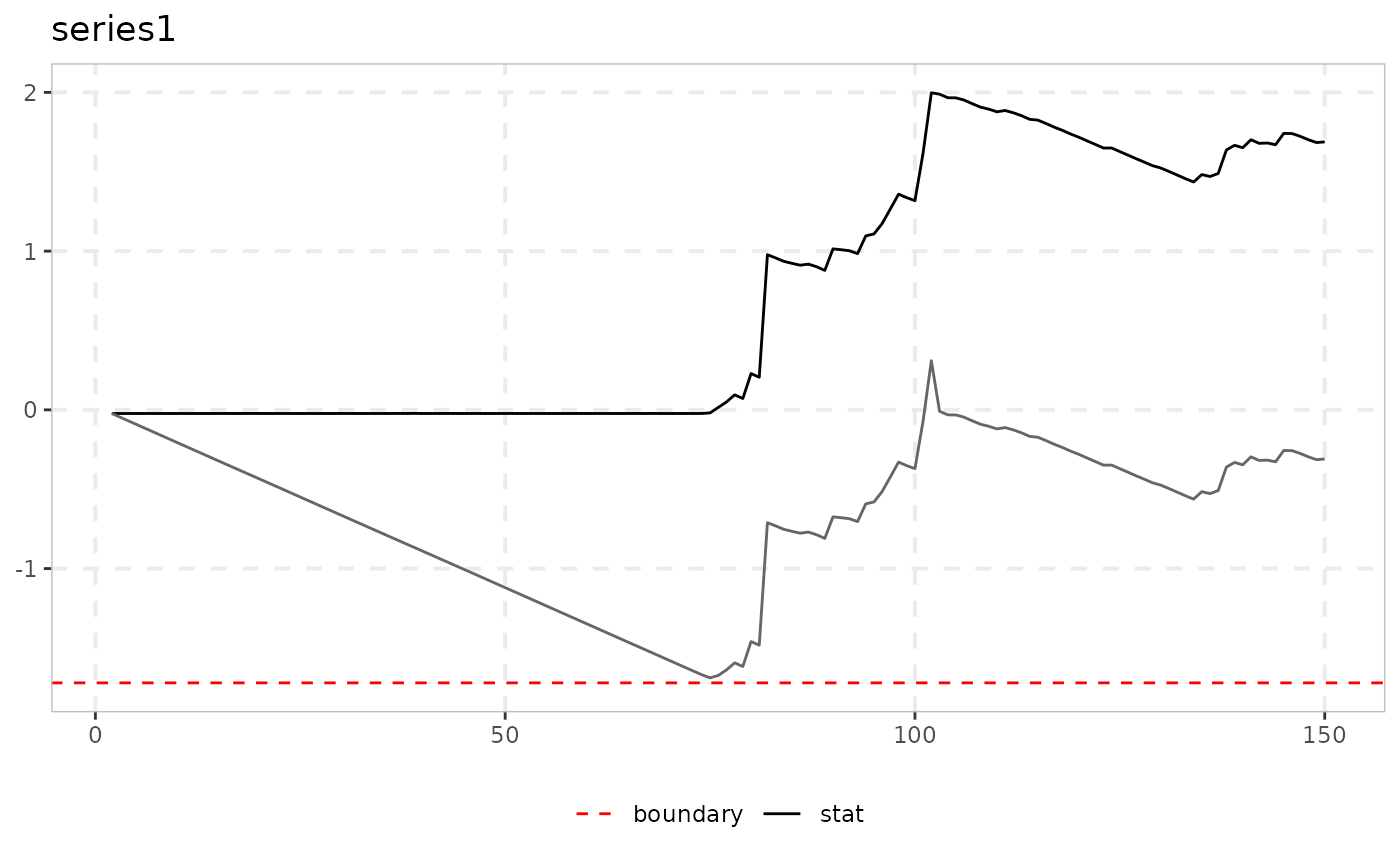
autoplot(cusum_test(y, type = "gcssq"))
#> Warning: Removed 151 rows containing missing values or values outside the scale range
#> (`geom_line()`).