
Reverse-Regression Dating of Crisis Origination and Market Recovery
Source:R/radf_recovery.R
radf_recovery.Rdradf_recovery implements the reverse-regression dating of Phillips & Shi
(2014). It reverses the series and runs the existing bsadf recursion of
radf() on it. It then locates the first up-crossing of a critical-value
boundary calibrated for the reversal, which is the market recovery date, and the
next down-crossing, which is the crisis (collapse) origination date in the
original series. Both are mapped back to the original time index.
Arguments
- data
A univariate or multivariate numeric time series object, a numeric vector or matrix, or a data.frame. A column may have leading or trailing
NAvalues, which describes an unbalanced panel in which series enter or exit the sample at different times. Those periods are filled withNAinbadfandbsadfand excluded from theadf,sadfandgsadfof that series. InteriorNAvalues (a gap in the middle of a series) are not supported. When any series is padded in this way, the panel statistics (bsadf_panelandgsadf_panel) are not available, and the function returnsNAfor them with a warning.- minw
A positive integer. The minimum window size (default = \((0.01 + 1.8/\sqrt{T})T\), where T denotes the sample size).
- lag
A non-negative integer. The lag length of the Augmented Dickey-Fuller regression (default = 0L).
- nrep
Number of Monte Carlo replications for the critical value in
radf_recovery_cv.- sig_lvl
Significance level, one of
90,95,99.- seed
Optional seed for the Monte Carlo draws.
Value
An object of class radf_recovery_obj: a list with f_c and
f_r (the estimated dates, NA if not identified), detected
(logical, whether an up-crossing was found at all) and censored (logical,
whether f_c is left-censored by the start of the reverse-time sample).
Details
The function returns two dates for each series. f_c is the crisis
origination (collapse-onset) date, a reverse-regression alternative to the
collapse date that datestamp already dates from the forward test.
f_r is the market recovery date, and f_c <= f_r always holds by
construction, because the down-crossing is searched only after the
up-crossing. If no up-crossing is found, neither date is identified (NA,
detected = FALSE). If an up-crossing is found but no later down-crossing
occurs before the reverse-time sample ends, f_c is NA and
censored = TRUE, which means that the crisis origination predates the
observed sample.
Note
The function returns its own class and not radf_obj, so it does not work
with summary(), \link{datestamp} and tidy. It has its own print() and
autoplot() methods instead.
print() shows the origination and recovery dates. See
vignette("naming-and-analysis", package = "exuber") for which functions fit
the shared pipeline and which do not.
Caveats
![[Experimental]](figures/lifecycle-experimental.svg)
Validation status (2026-08-10). f_r (the recovery date)
validates well against synthetic collapse-then-recovery data. Its bias is in the
same range as in the Monte Carlo study of the paper, a few observations early.
f_c (the crisis origination date) shows a materially larger residual bias
in Monte Carlo checks. The empirical false-detection rate under a pure
random-walk null (n = 100, minw = 20, 95\
than the comparable numbers for the forward tests elsewhere in this package. We
found and fixed one artifact of the synthetic process during validation, where a
level jump at a regime boundary produced a spurious spike. The remaining bias in
f_c and the elevated false-detection rate are not fully explained. They
may be genuine finite-sample noise from the literal first-down-crossing rule of
the paper. The inf in its eq. 9 has no persistence requirement, so a
transient dip below the boundary is enough to trigger a premature f_c. We
have not ruled out a subtler implementation issue. Treat f_c and the
overall detection rate as exploratory until they are validated further, and see
docs/dating-and-root-inference.md for the full numbers. The function emits the
same short pointer as a message when it is called (use
suppressMessages to silence it) and stores it as
attr(x, "caveat") on the returned object.
References
Phillips, P. C. B., & Shi, S. (2014). Financial Bubble Implosion and Reverse Regression. Cowles Foundation Discussion Paper No. 1967, Yale University. Published in Econometric Theory.
See also
datestamp for the forward, non-reversed dating of
origination and collapse that this function complements.
Other dating:
dating_hls(),
dating_hlw(),
dating_knp(),
dating_pdc(),
rootstamp()
Examples
# \donttest{
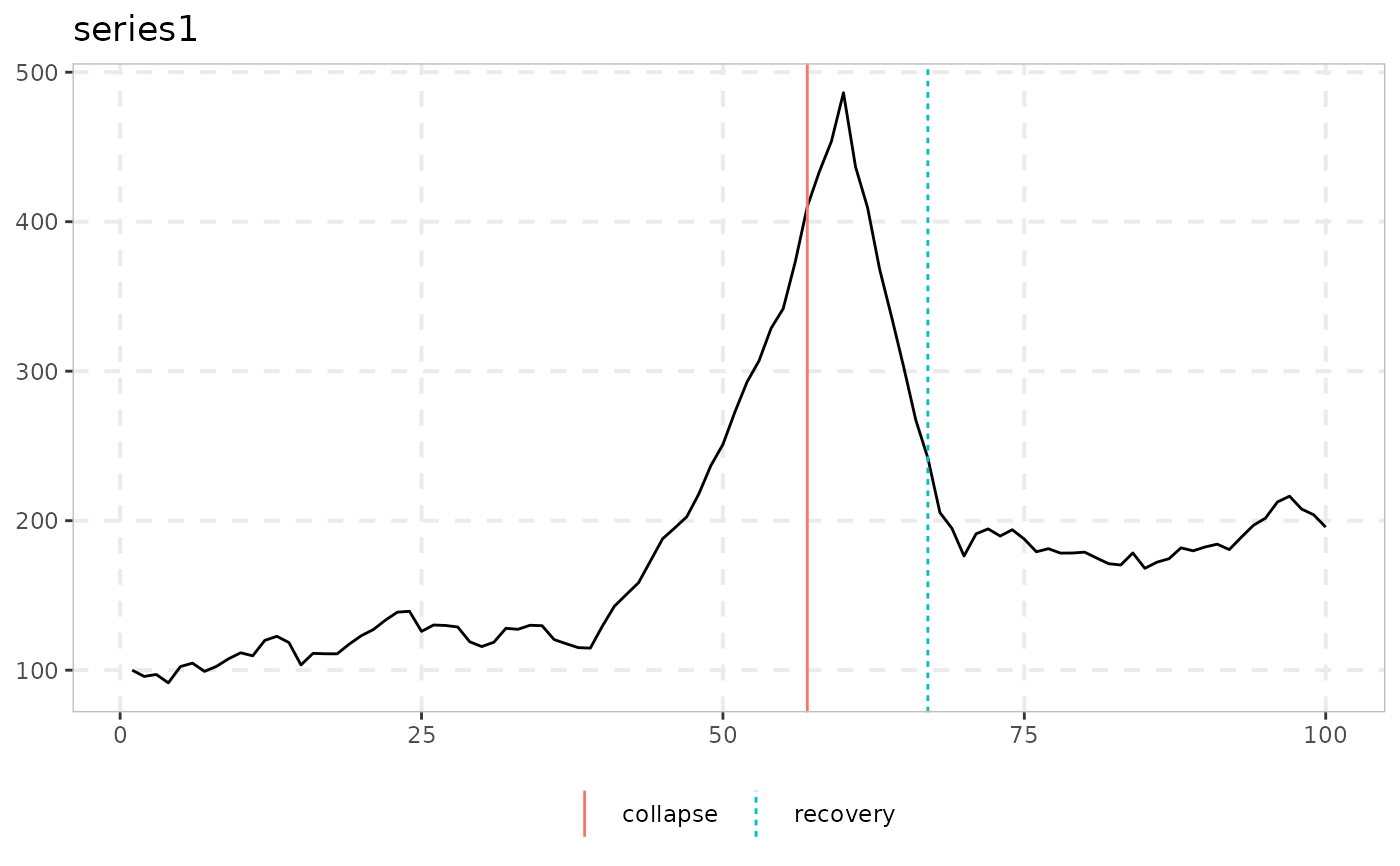
# The expansion, bubble, collapse and recovery process of sim_ps1()
y <- sim_ps1(n = 100, seed = 1)
res <- radf_recovery(y, minw = 15, nrep = 200, seed = 1)
#> Experimental. f_c and the overall false-detection rate are exploratory pending further validation; see ?radf_recovery, Caveats section.
print(res)
#>
#> ── radf_recovery (n = 100, minw = 15, level = 95%) ─────────────────────────────
#>
#> ℹ Experimental. f_c and the overall false-detection rate are exploratory pending further validation; see ?radf_recovery, Caveats section.
#>
#> series f_c f_r detected censored
#> series1 57 67 TRUE FALSE
#>
# Plot the series with the estimated collapse (f_c) and recovery (f_r) points
autoplot(res)
 # }
# }