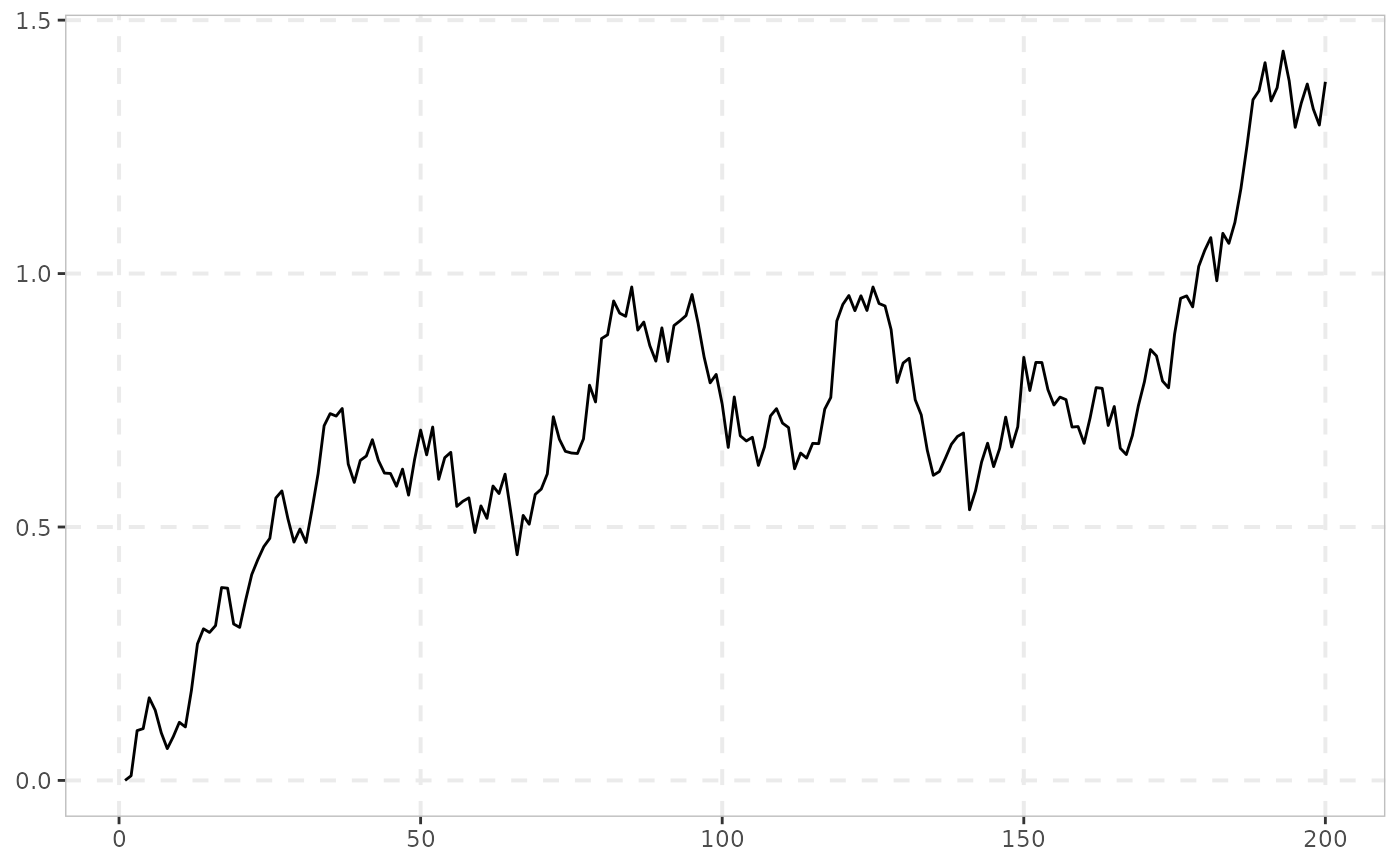
Simulation of Chan & Santi (2021)'s bubble component of a present-value
state-space model: an AR(1) whose persistence switches between a
"surviving" (explosive) and a "collapsing" (mean-reverting) regime under
a first-order Markov chain, rather than at deterministic dates
(sim_psy1) or a fixed-probability mixture
(sim_blan).
Usage
sim_msbubble(
  n,
  p11 = 0.98,
  p22 = 0.9,
  lambda1 = 0.98,
  lambda2 = 1.03,
  sigma_b = 0.05,
  b0 = 0,
  s0 = 1L,
  seed = NULL
)
Arguments
- n
A positive integer specifying the length of the simulated output series.
- p11, p22
Regime-1-to-1 and regime-2-to-2 transition probabilities, in (0, 1).
- lambda1, lambda2
Regime persistence parameters (
lambda1 < 1explosive,lambda2 > 1mean-reverting).- sigma_b
A positive scalar, the bubble-innovation standard deviation.
- b0
Starting value.
- s0
Starting regime,
1Lor2L.- seed
An object specifying if and how the random number generator (rng) should be initialized. It is either NULL or an integer, which is passed to
set.seedbefore the simulation. If you set it, the value is saved as the "seed" attribute of the returned value. The default, NULL, leaves the state of the rng unchanged and returns .Random.seed as the "seed" attribute. Results are reproducible across the parallel and the non-parallel option when you use the same seed.
Details
$$b_t = \frac{1}{\lambda_{S_t}}b_{t-1}+\epsilon_t^b,\quad
\epsilon_t^b \sim iid\,N(0,\sigma_b^2)$$
with \(S_t \in \{1,2\}\) a Markov chain with transition
probabilities p11 = P(S[t]=1|S[t-1]=1), p22 =
P(S[t]=2|S[t-1]=2). Regime 1 ("surviving") uses lambda1 < 1
(so 1/lambda1 > 1, explosive); regime 2 ("collapsing") uses
lambda2 > 1 (mean-reverting). Note: the source's own eq. 16 indexes
the coefficient by \(S_{t+1}\); this implementation uses the
contemporaneous \(S_t\) instead (an indexing-convention
simplification, not a change to the qualitative Markov-switching
mechanism).