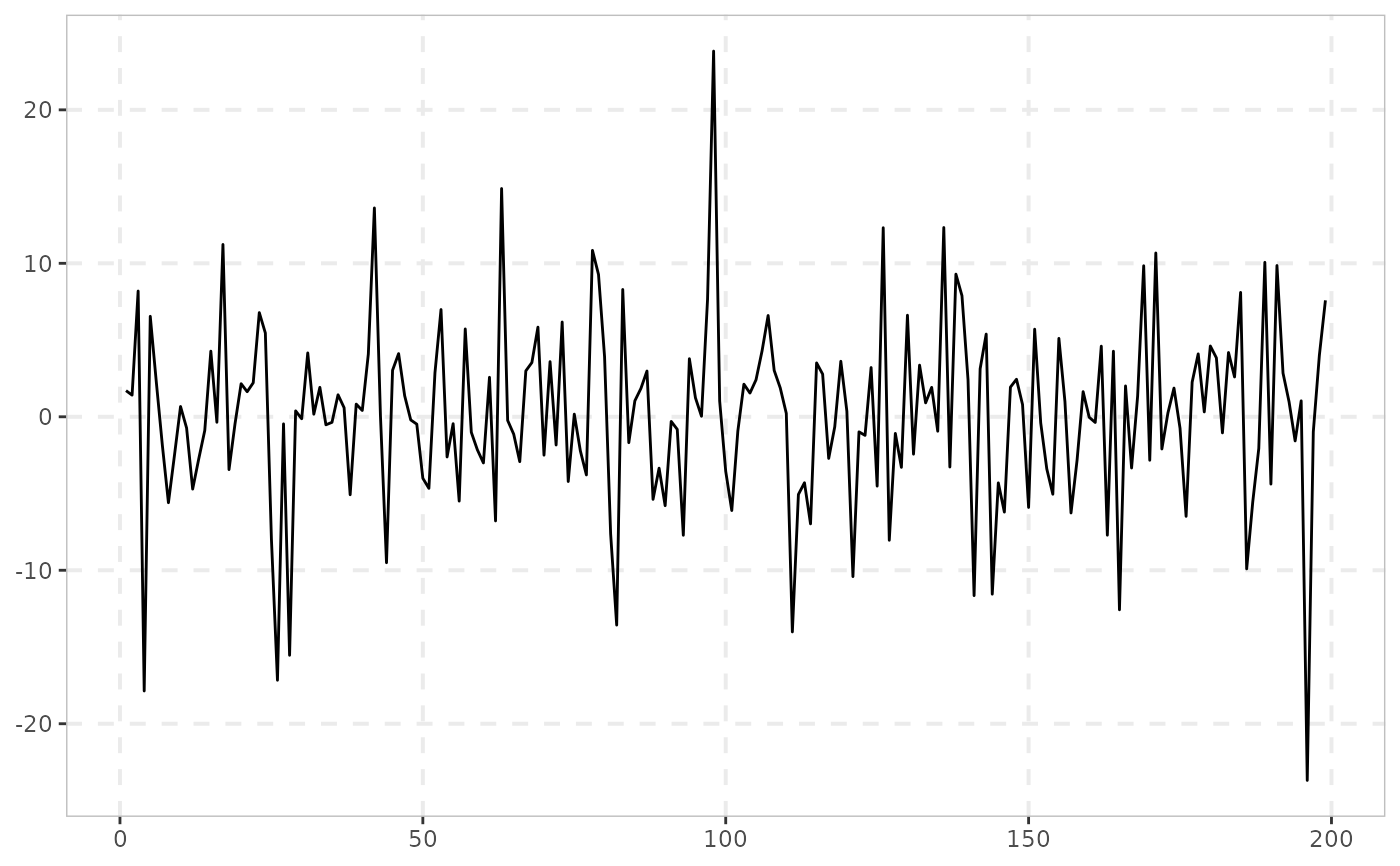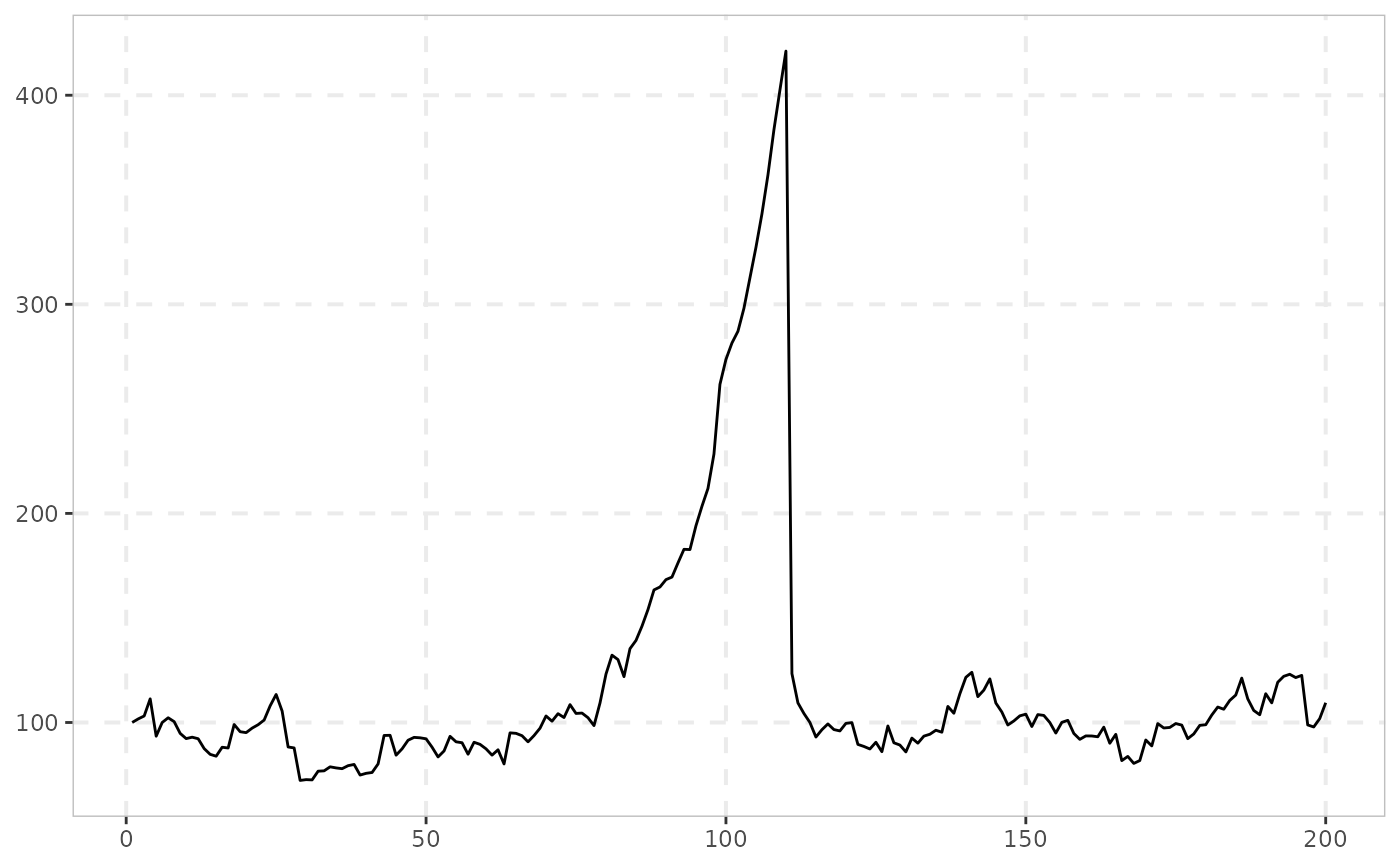
Generates a shock sequence for use with the PSY-style mean equations
(sim_psy1 and sim_psy2) but with a non-Gaussian
marginal distribution. The sequence is standardized to mean 0 and variance
sigma^2, so it fits directly into sim_psy1(..., e = sim_innov(...)).
Usage
sim_innov(
  n,
  dist = c("normal", "t", "skew_t"),
  sigma = 6.79,
  df = 5,
  xi = 0,
  seed = NULL
)
Arguments
- n
Number of innovations to generate.
- dist
One of
"normal","t","skew_t".- sigma
A positive scalar indicating the standard deviation of the innovations.
- df
Degrees of freedom for
"t"/"skew_t"(> 2).- xi
Skewness parameter for
"skew_t"(any real; 0 = symmetric).- seed
An object specifying if and how the random number generator (rng) should be initialized. It is either NULL or an integer, which is passed to
set.seedbefore the simulation. If you set it, the value is saved as the "seed" attribute of the returned value. The default, NULL, leaves the state of the rng unchanged and returns .Random.seed as the "seed" attribute. Results are reproducible across the parallel and the non-parallel option when you use the same seed.
Details
dist = "t" rescales a Student-t(df) draw to variance 1 before
scaling by sigma. This is exact and closed form, because
Var(t_df) = df / (df - 2). dist = "skew_t" combines two independent
standardized Student-t draws in the manner of Azzalini,
delta * abs(T0) + sqrt(1 - delta^2) * T1 with
delta = xi / sqrt(1 + xi^2), and then standardizes the result with the
closed-form mean and variance of that combination (E|T0| is itself closed
form through the Beta function). xi > 0 skews the distribution to the
right, xi < 0 skews it to the left, and xi = 0 gives the symmetric
t case.
References
Wu, R., Shi, S. & Wu, J. (2025). "Quantile analysis for financial bubble detection and surveillance." JTSA, 46(5), 908-931 (uses N(0,1)/t(3)/skewed-t(3, -0.75)/skewed-t(3, 0.75) innovations in their Monte Carlo design, eq. 6).