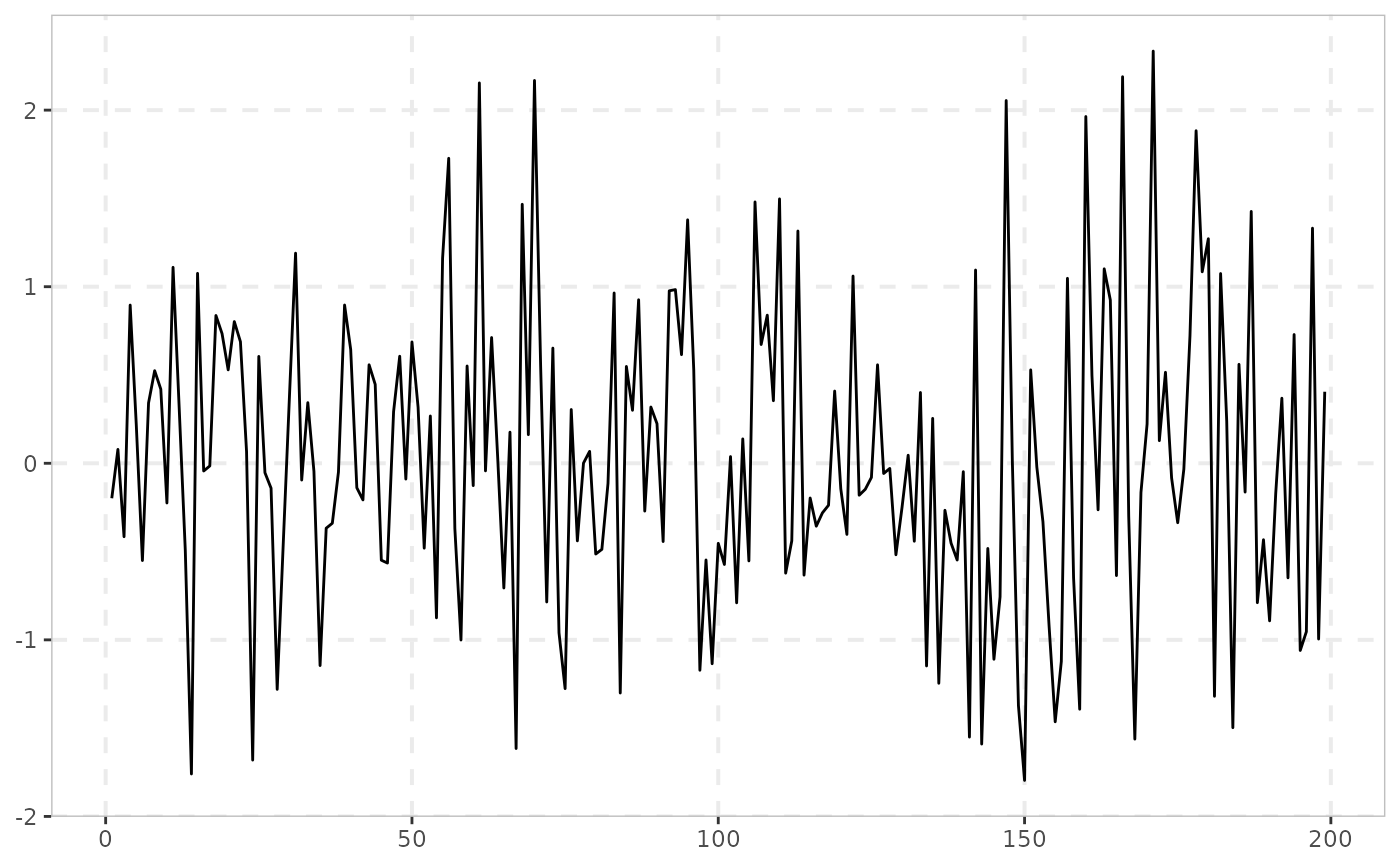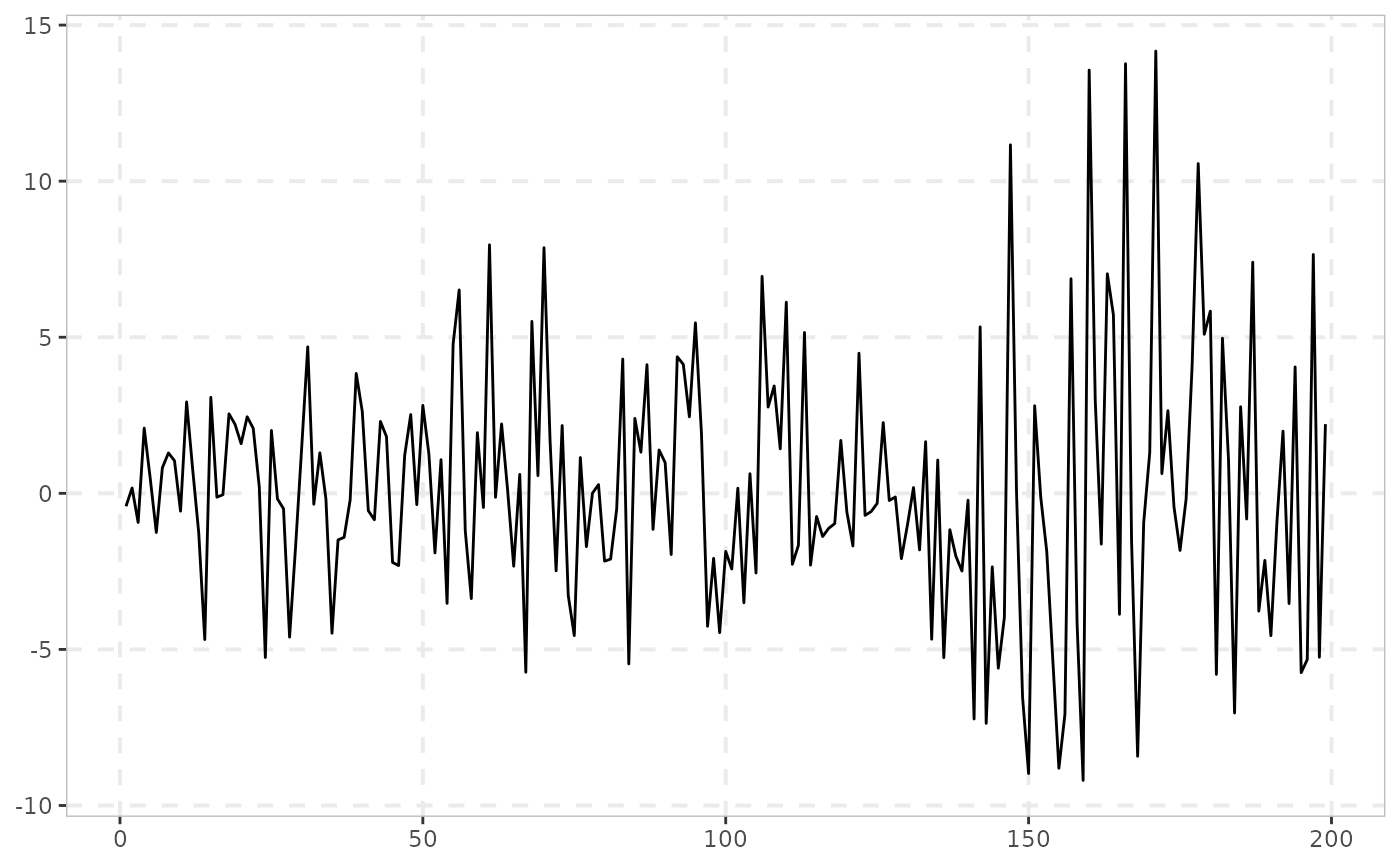
Generates shocks z_t = sqrt(h_t) * eps_t from a GARCH(1,1) recursion with
an optional threshold (leverage) term, for use as
sim_psy1(..., e = sim_vol_garch(...)).
Arguments
- n
Number of innovations to generate.
- omega, alpha, beta
Positive GARCH(1,1) parameters. The defaults (
omega = 0.1, alpha = 0.1, beta = 0.8) match Whitehouse, Harvey & Leybourne (2025) and Harvey, Leybourne, Taylor & Zu (2024).- gamma
Non-negative TGARCH leverage parameter. The NASDAQ calibration of Monschang & Wilfling (2021) is
omega = 0.4387, alpha = 0, beta = 0.9319, gamma = 0.1306.- seed
An object specifying if and how the random number generator (rng) should be initialized. It is either NULL or an integer, which is passed to
set.seedbefore the simulation. If you set it, the value is saved as the "seed" attribute of the returned value. The default, NULL, leaves the state of the rng unchanged and returns .Random.seed as the "seed" attribute. Results are reproducible across the parallel and the non-parallel option when you use the same seed.
Details
$$z_t = \sqrt{h_t}\,\epsilon_t,\quad h_t = \omega + \alpha z_{t-1}^2 + \beta h_{t-1} + \gamma z_{t-1}^2 1\{z_{t-1}<0\}$$
with \(\epsilon_t \sim NIID(0,1)\) and
\(h_0 = z_0 = 0\). gamma = 0 (the default) gives plain GARCH(1,1), and
gamma > 0 adds the TGARCH leverage effect, a larger response to negative
shocks.
References
Whitehouse, E.J., Harvey, D.I. & Leybourne, S.J. (2025). "Real-time monitoring of explosive financial bubbles." Monschang, V. & Wilfling, B. (2021). "Sup-ADF-style bubble-detection methods under test." Empirical Economics, 61, 145-172.