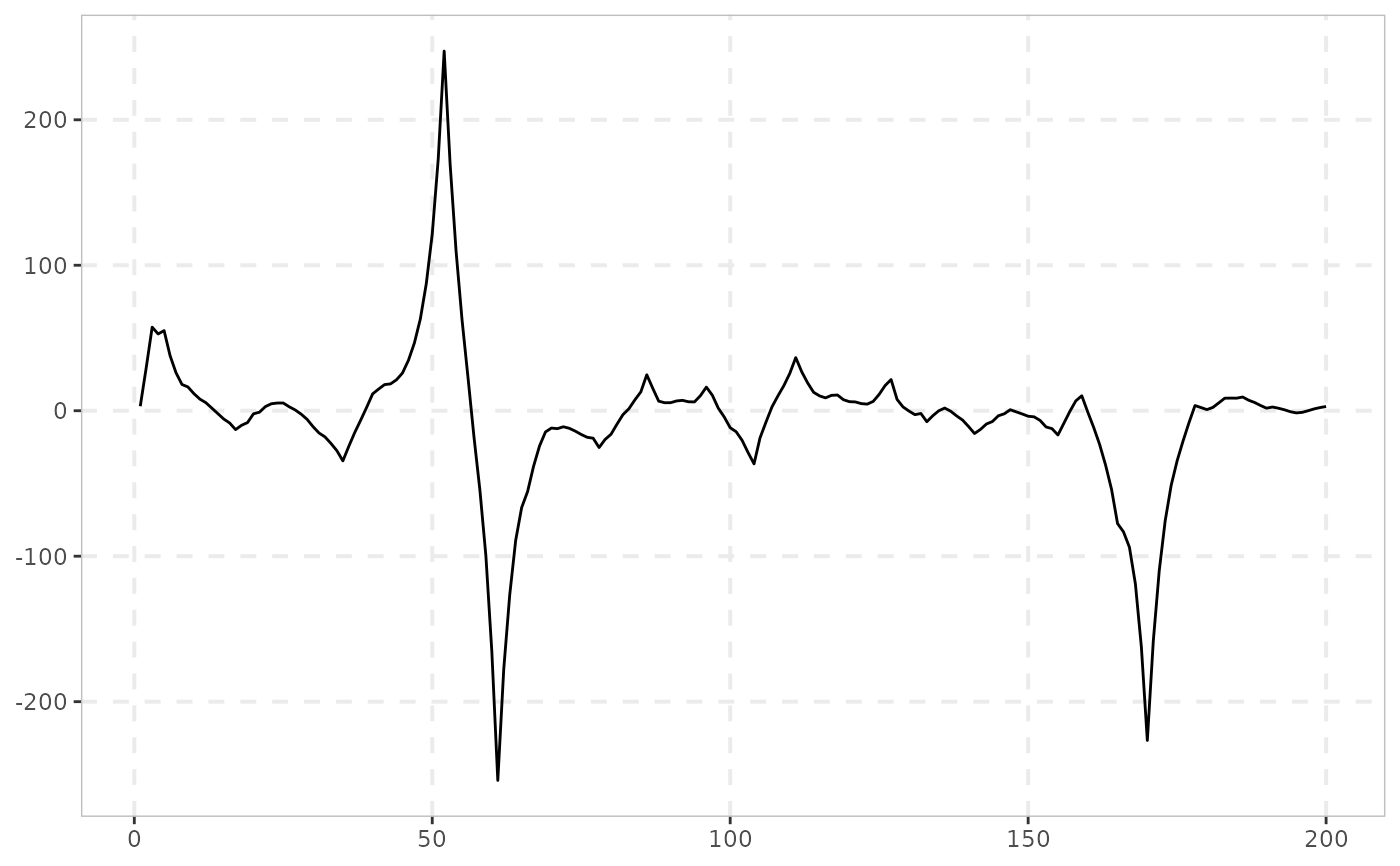
Simulates the mixed causal-noncausal autoregressive (MAR) bubble process of
Blasques, Koopman, Mingoli & Telg (2025). Transient, self-terminating local
bubbles arise on their own from the noncausal (forward-looking) component.
Unlike sim_psy1, no origination or collapse dates are scripted.
Usage
sim_mar(
  n,
  phi1 = 0.7,
  psi1 = 0.7,
  dist = c("cauchy", "t"),
  df = 2,
  burn = 100,
  seed = NULL
)
Arguments
- n
A positive integer specifying the length of the simulated output series.
- phi1
Causal AR coefficient, in (0, 1).
- psi1
Noncausal AR coefficient, in (0, 1).
- dist
Innovation distribution:
"cauchy"or"t"(withdfdegrees of freedom).- df
Degrees of freedom if
dist = "t".- burn
Non-negative burn-in length applied at both ends (see Details).
- seed
An object specifying if and how the random number generator (rng) should be initialized. It is either NULL or an integer, which is passed to
set.seedbefore the simulation. If you set it, the value is saved as the "seed" attribute of the returned value. The default, NULL, leaves the state of the rng unchanged and returns .Random.seed as the "seed" attribute. Results are reproducible across the parallel and the non-parallel option when you use the same seed.
Details
$$(1-\phi_1 L)(1-\psi_1 L^{-1})y_t = \epsilon_t$$
The function uses the standard two-sided filtering method for MAR processes
(Lanne & Saikkonen 2011; Gourieroux & Zakoian 2017). It generates the noncausal
component by running \(u_t=\psi_1 u_{t+1}+\epsilon_t\) backward from a zero boundary burn
observations past the end of the sample. It then generates the causal component
by running \(y_t=\phi_1 y_{t-1}+u_t\) forward
from a zero boundary burn observations before the start. Both burn-in
windows are then dropped.
References
Blasques, F., Koopman, S.J., Mingoli, G. & Telg, S. (2025). "A Novel Test for the Presence of Local Explosive Dynamics." JTSA, 46(5), 966-980.