
cobubble_test tests whether two series that each contain an explosive
episode are co-explosive. That is, it tests whether the linear combination
y_t - alpha - beta * x_{t-lag} is stationary, so that the explosive
dynamics in y and x are the same underlying phenomenon, possibly
migrating from one series to the other with a lead or lag, and not independent
explosive episodes.
Arguments
- y, x
Numeric vectors of equal length, or objects that
as.numeric()can coerce to one.xis the candidate regressor with the explosive episode, andyis tested for co-explosivity withx_{t-lag}.- lag
The lead or lag
iinx_{t-lag}. IfNULL(default), it is estimated fromlag_gridby minimizing the residual variance (i_hatin Section VI).- lag_grid
Candidate lag values searched when
lag = NULL. The default-6:6follows the simulation design of the paper.- nboot
Number of wild bootstrap replications.
- sig_lvl
Significance level, on the same 0 to 100 scale as the
sig_lvlofdatestamp(default95, which gives a 5\ upper-tail rejection region).- seed
Optional seed for the bootstrap draws.
Value
An object of class cobubble_test_obj: a list with the observed
statistic S, the (given or estimated) lag, the bootstrap critical
value cv at sig_lvl, the bootstrap p-value p_value and
reject, which is TRUE if S exceeds cv, that is, if
co-explosivity is rejected.
Details
radf is a right-tailed ADF-family test for the presence of
explosiveness. This function is a stationarity (KPSS-type) test instead. The null
hypothesis is co-explosivity, that is, that the residuals of y regressed on
a constant and x_{t-lag} are I(0). The null limiting distribution of the
statistic depends on the pattern of heteroskedasticity in the errors (Evripidou,
Harvey, Leybourne & Sollis 2022, Theorem 1). The critical values therefore come
from a wild bootstrap that reproduces this pattern of heteroskedasticity in the
bootstrap samples (Theorem 2).
Note
The critical value comes from a wild bootstrap of the residuals (Theorem 2), which is computed internally in each call. There is no separate, reusable cv function for this test.
The function returns its own class and not radf_obj, so it does not work
with summary(), \link{datestamp} and tidy. It has its own print() and
autoplot() methods instead. print() shows the statistic, the critical value and the p-value. See
vignette("naming-and-analysis", package = "exuber") for which functions fit
the shared pipeline and which do not.
![[Experimental]](figures/lifecycle-experimental.svg)
References
Evripidou, A. C., Harvey, D. I., Leybourne, S. J., & Sollis, R. (2022). Testing for co-explosive behaviour in financial time series. Oxford Bulletin of Economics and Statistics, 84(3), 624-650.
See also
Other multivariate:
contagion_reg(),
radf_common()
Examples
# \donttest{
# A co-explosive pair (the process of Evripidou et al.), which is not rejected
xy <- sim_coexplosive(n = 100, seed = 123)
res <- cobubble_test(xy$y, xy$x, nboot = 199L, seed = 1)
print(res)
#>
#> ── cobubble_test (lag = 0, nboot = 199) ────────────────────────────────────────
#>
#> S = 0.2364, cv(95%) = 0.4048, p-value = 0.1508
#> Co-explosivity not rejected at the 5% level.
#>
# Force a specific lead or lag instead of estimating it
res_lag0 <- cobubble_test(xy$y, xy$x, lag = 0L, nboot = 199L, seed = 1)
print(res_lag0)
#>
#> ── cobubble_test (lag = 0, nboot = 199) ────────────────────────────────────────
#>
#> S = 0.2364, cv(95%) = 0.4048, p-value = 0.1508
#> Co-explosivity not rejected at the 5% level.
#>
# Two independent bubbles: co-explosivity correctly rejected
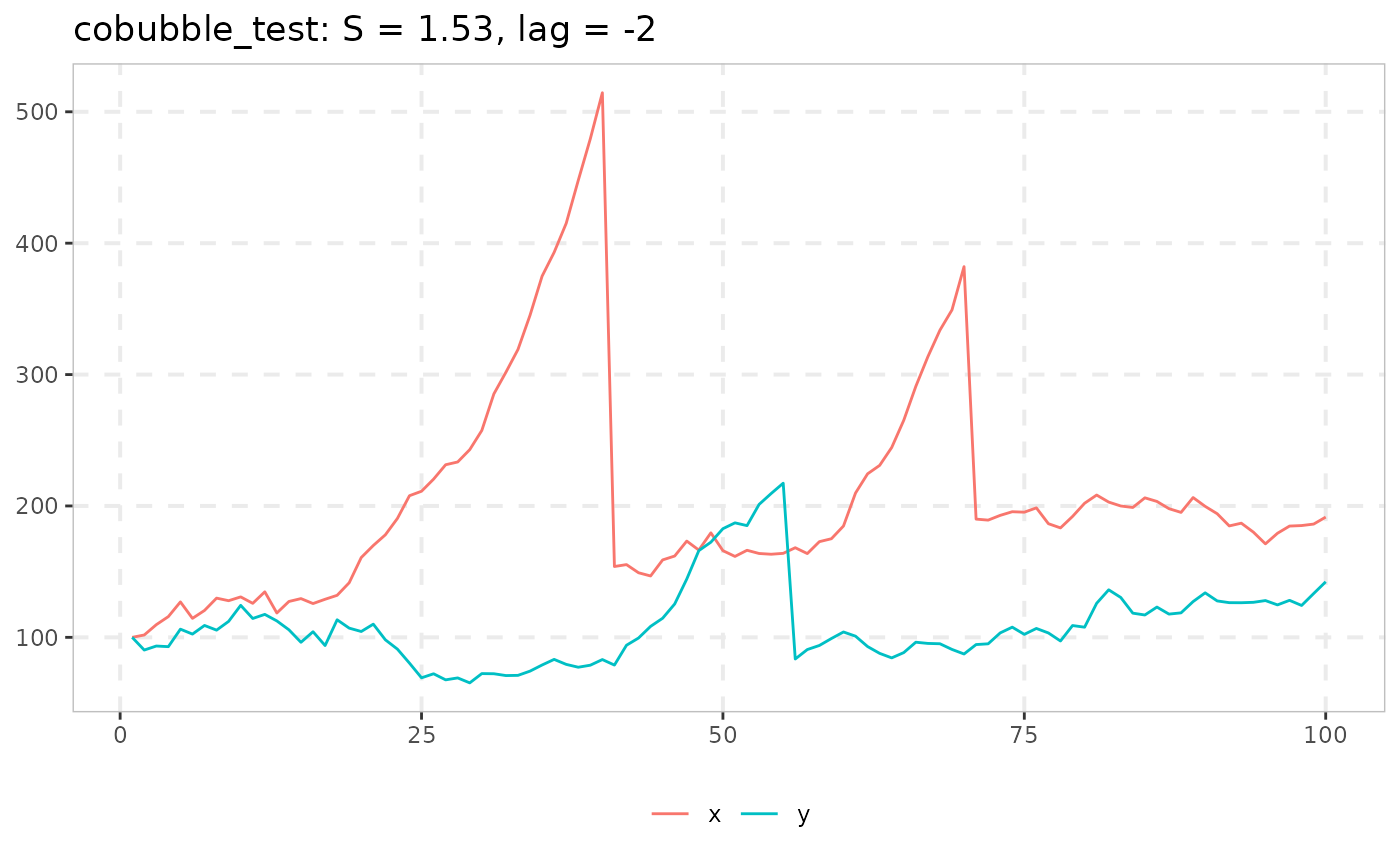
cobubble_test(sim_data$psy1, sim_data$psy2, nboot = 199L, seed = 1)
#>
#> ── cobubble_test (lag = -2, nboot = 199) ───────────────────────────────────────
#>
#> S = 1.533, cv(95%) = 0.2998, p-value = 0
#> Co-explosivity rejected at the 5% level.
#>
# Plot the two series that are tested for co-explosivity
autoplot(res)
 # }
# }